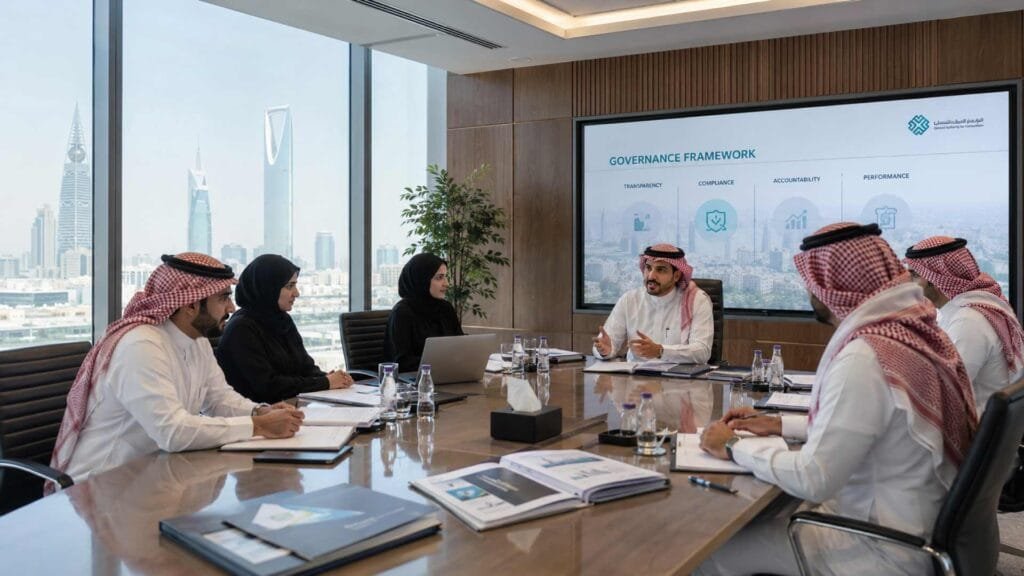
Corporate governance is not merely formal procedures; it is an integrated management philosophy that creates a real difference in the business environment. At the Arab Center for Consulting, we believe implementing governance in Saudi companies represents a fundamental pillar for achieving sustainable growth, attracting investment, and enhancing trust in the business ecosystem, especially in light of the ambitious Saudi Vision 2030 objectives.
The Role of Governance in Enhancing Transparency and Accountability in Economic Sectors in Saudi Companies

Mechanisms for Enhancing Disclosure and Transparency in Saudi Governance Frameworks
Transparency and accountability are among the most prominent outcomes of implementing effective corporate governance in Saudi companies. Effective Saudi corporate governance frameworks in Saudi Arabia mandate that companies publish essential financial, operational, and organizational information, alongside risk management strategies. The Saudi Capital Market Authority (CMA) plays a pivotal role by establishing stringent disclosure and transparency systems in the Saudi market and ensuring regulatory compliance across the market. At the Arab Center, we assist firms in developing comprehensive disclosure policies that build market credibility and solidify investor confidence. Studies indicate that compliant firms achieve significantly higher market valuations than their peers. Beyond mere compliance, governance effectively mitigates conflicts of interest among board members, executive management, and shareholders, ensuring that strategic decisions prioritize the company’s supreme interests over personal gains. Furthermore, robust mechanisms for accountability and protection of shareholder rights protect minority shareholders, providing them with effective channels for decision-making participation. Governance and compliance with Saudi regulations are indispensable requirements for any company aiming to build a solid reputation in the local and regional market.
Request a comprehensive governance gap analysis of your company to assess current transparency and compliance levels and identify immediate areas for strategic improvement.
How Governance Enhances Financial and Operational Performance Efficiency
The Role of Governance in Enterprise Risk Management and Improving Corporate Credit Ratings
The benefits of corporate governance extend far beyond regulatory compliance. The impact of governance on improving the efficiency of financial and operational performance of companies. Diverse, independent boards of directors, supported by specialized audit, nomination, and remuneration committees, ensure that data-driven decisions mitigate corporate risks while unlocking growth opportunities. Proactive enterprise risk management, enforced by governance frameworks, enables Saudi firms to identify, evaluate, and neutralize threats before they escalate into costly crises. Documented the role of governance in enhancing financial performance. Financial studies confirm that governance-compliant businesses generate higher returns and enjoy superior credit ratings in capital markets.
At the Arab Center for Consulting, we help clients foster an organizational culture rooted in integrity and responsibility, which directly boosts employee productivity and strategic alignment. Ultimately, corporate governance standards in the board of directors reduce decision-making bias, enhance oversight, and optimally allocate resources toward long-term strategic objectives, directly increasing market value and competitive advantage.
Request an executive report linking governance to your financial performance before major financing decisions. Request a price quote for our services now.
You can also read:
- A Guide to Establishing Companies in Saudi Arabia
- Best Feasibility Study Office in Riyadh
- Guide to Registration for Zakat and Income Tax
The Impact of Governance in Attracting Foreign Investment and Gulf Expansion
Aligning Governance Policies with Gulf Expansion and External Investment Plans
Foreign investors prioritize reliable, transparent environments before making capital commitments. Governance serves as the primary benchmark for measuring investment safety in Saudi companies, as advanced frameworks minimize legal and financial risks while opening horizons for international partnerships. The Saudi Vision 2030 governance framework enhances global investor confidence by aligning local practices with international standards, such as the OECD guidelines. The importance of governance for Gulf investors when evaluating expansion opportunities in Saudi Arabia bridges the gap between governance quality and joint venture attractiveness for Gulf investors expanding into Saudi Arabia.
At the Arab Center for Consulting, we deliver integrated solutions that align corporate frameworks with Gulf investment standards. Saudi Vision 2030 structural reforms continue to encourage international alliances, ensuring that well-governed firms secure abundant financing at lower costs. The role of governance in attracting foreign investment to Saudi companies indicates that companies with established governance frameworks attract more funding at a lower cost. Moreover, governance and corporate social responsibility have become essential evaluation criteria for investment funds and institutional investors seeking sustainability.
Book a specialized consultation with the Arab Center for Consulting to establish a governance framework supporting Gulf expansion and foreign investment.
Key Challenges in Family Business Governance and Digital Governance
Best Practices for Family Business Governance in the Gulf
Family businesses face unique challenges in the Gulf, primarily the overlapping roles of ownership and management, which lead to conflicts of interest and decision-making deadlocks. Family constitutions and structured ownership transition frameworks represent the most effective solutions for managing generational succession and mitigating internal disputes. At the Arab Center for Consulting, we specialize in implementing governance for Saudi and Gulf family businesses to maintain family cohesion and ensure multi-generational business sustainability. This process involves establishing family councils, independent advisory boards, and formalized dispute resolution mechanisms according to approved family governance frameworks.
Practical Steps to Build a Governance Framework Aligned with CMA and Digital Governance Requirements
Simultaneously, rapid digital transformation has made digital governance and digital transformation in companies an indispensable component of comprehensive corporate governance frameworks. Requirements of the Saudi Capital Market Authority for the governance of listed companies mandate that listed entities adopt modern technologies that accelerate disclosures and guarantee compliance with newly introduced regulations. Corporate governance for small and medium enterprises in Saudi Arabia also requires flexible approaches that suit their size and circumstances while ensuring the long term benefits of implementing effective governance. The Arab Center offers comprehensive digital solutions, such as electronic board management systems and real-time disclosure platforms, to help companies keep up with private sector governance and support the national economy.
The best governance practices in the Gulf allow companies to move beyond mere compliance to building a real competitive advantage. Corporate governance of companies listed on the financial market embodies this transformation through strict oversight mechanisms and periodic disclosure requirements. The corporate governance consultations provided by the Arab Center for Consulting reflect a steadfast commitment to assisting clients in corporate governance in Saudi Arabia according to the highest local and international standards. And the governance standards according to Vision 2030 represent a clear roadmap toward a more transparent and competitive business environment.
Obtain a governance feasibility study assessing the impact of developing governance on your company’s market value and investment attractiveness. Visit our website: Arab Center for Consulting.
You can also read:
- Discover the Best Financial Consulting Firm in Saudi Arabia
- Mechanism for Disclosing Deferred VAT on imports
- The US Iran War and its Tax and Economic Impact
Conclusion:
Governance is an absolute strategic necessity, not an optional luxury, for Saudi companies aiming for sustainable growth under Vision 2030. It represents a real investment in building an organizational culture based on fairness, transparency and accountability. This translates directly into optimized financial performance, robust risk management, and increased investor attraction. At the Arab Center for Consulting, we firmly believe that the governance transformation journey is a continuous process that deserves full investment, as its long-term corporate returns far outweigh the initial implementation costs, positioning your enterprise at a premium competitive advantage both locally and regionally.
Contact us at the Arab Center for Consulting to update your corporate governance system in compliance with the Saudi Capital Market Authority regulations.
Frequently Asked Questions:
What are the most important corporate governance requirements in the current Saudi market?
The Saudi Capital Market Authority requires an active board of directors that includes independent members, along with specialized committees for audit, nominations, and remuneration. Governance regulations also mandate periodic disclosure of material information, implementation of clear conflict-of-interest policies, and compliance with approved international accounting standards.
How does governance affect the decisions of local and foreign investors?
Governance is a decisive factor in investment choices, reflecting the level of trust and transparency within a firm. Investors actively seek companies with robust governance structures that guarantee the protection of their rights and minimize operational risks. Studies show that strongly governed companies achieve higher market performance and lower financing costs.
What is the difference between family business governance and listed companies in the Gulf?
The governance of listed companies focuses primarily on regulatory disclosure requirements, protecting minority shareholder rights, and complying with capital market regulations. Conversely, family business governance addresses the complexities of overlapping ownership and management, generational power transitions, and organizing family relationships through family constitutions and advisory boards.
How can digital governance be integrated into the traditional governance framework?
Integrating digital governance begins with assessing the existing governance system and identifying technological gaps. This is followed by adopting electronic board management systems, real-time disclosure platforms, and AI-powered risk management tools. The Arab Center helps companies build integrated digital roadmaps to modernize their governance frameworks.